The aging warrior-king of the Danish Valdemarian Age, ready for the Baltic crusades.
By 1240, Valdemar II Sejr (“the Victorious”) had ruled Denmark for almost four decades, since 1202. In his youth he turned Denmark into the dominant power of the Baltic. He conquered Holstein and Mecklenburg and brought northern Estonia under the Danish crown. According to later tradition, the Dannebrog fell from the sky during the 1219 battle at Lindanise (Tallinn). No contemporary source says this, and the story was recorded only centuries later, but it remains central to Danish identity.
His reign was not all triumph. In 1223 he was kidnapped during a hunting trip by Count Henry of Schwerin and held captive for over two years. Danish power in northern Germany was largely lost at the Battle of Bornhöved in 1227, but Estonia remained Danish. In his last years he turned to law and administration. The Liber Census Daniae, a land and revenue survey, dates to his reign, and the Jutland Law (Jyske Lov) was proclaimed in spring 1241, just before his death on 28 March 1241. It opens with the principle that the land shall be built with law.
This model shows the king around 1240, an experienced man of about seventy who is still every inch a warrior.
The model
Pose: A calm, commanding standing pose with weight on one leg. The sword is planted point-down at the right foot like a symbol of authority, held in a relaxed ready position. The heater shield hangs lowered at the left side, so he looks watchful rather than mid-combat. He stands on a small rocky base.
Armour: Full mail hauberk with long sleeves and mail chausses (leg armour), worn under a sleeveless surcoat gathered at the waist with a belt. This is typical for a high-status warrior in the first half of the 13th century.
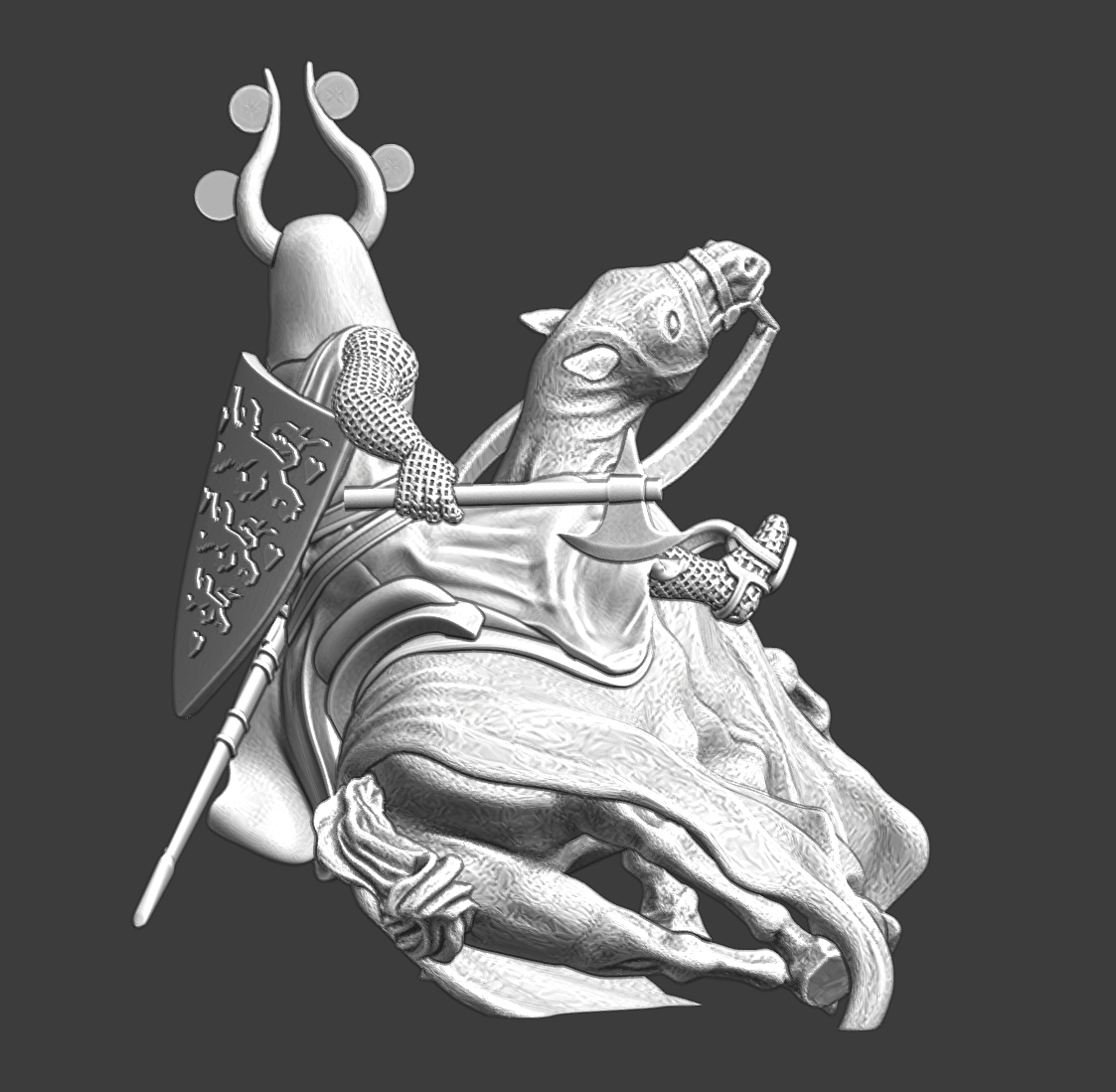
Helmet: A great helm with a perforated face area, topped by tall curved horns ending in discs. Horned crests were a fashionable heraldic display across the Holy Roman Empire and the Baltic region in the 13th century. They are medieval and have nothing to do with Vikings, so this is a good chance to correct the old myth.
Weapons: A cruciform-hilted arming sword and a curved heater shield with relief decoration, ready for your own heraldic freehand or decals.
Painting ideas: The Danish royal arms of three blue lions among red hearts on gold are attested from this period. A plain red field with a white cross also works, in line with the Dannebrog tradition.
Historical note: Valdemar’s personal helmet crest isn’t securely documented. This model is a plausible interpretation based on the style of the period.
Uses: Danish and Baltic Crusades, Northern Crusades wargaming, Lion Rampant, SAGA Crusades, Dux Bellorum, Dark Ages and medieval RPGs, and historical dioramas.
Supported/Unsupported
Описания пока нет. Вы можете добавить его.





 Our Telegram channels and bot:


